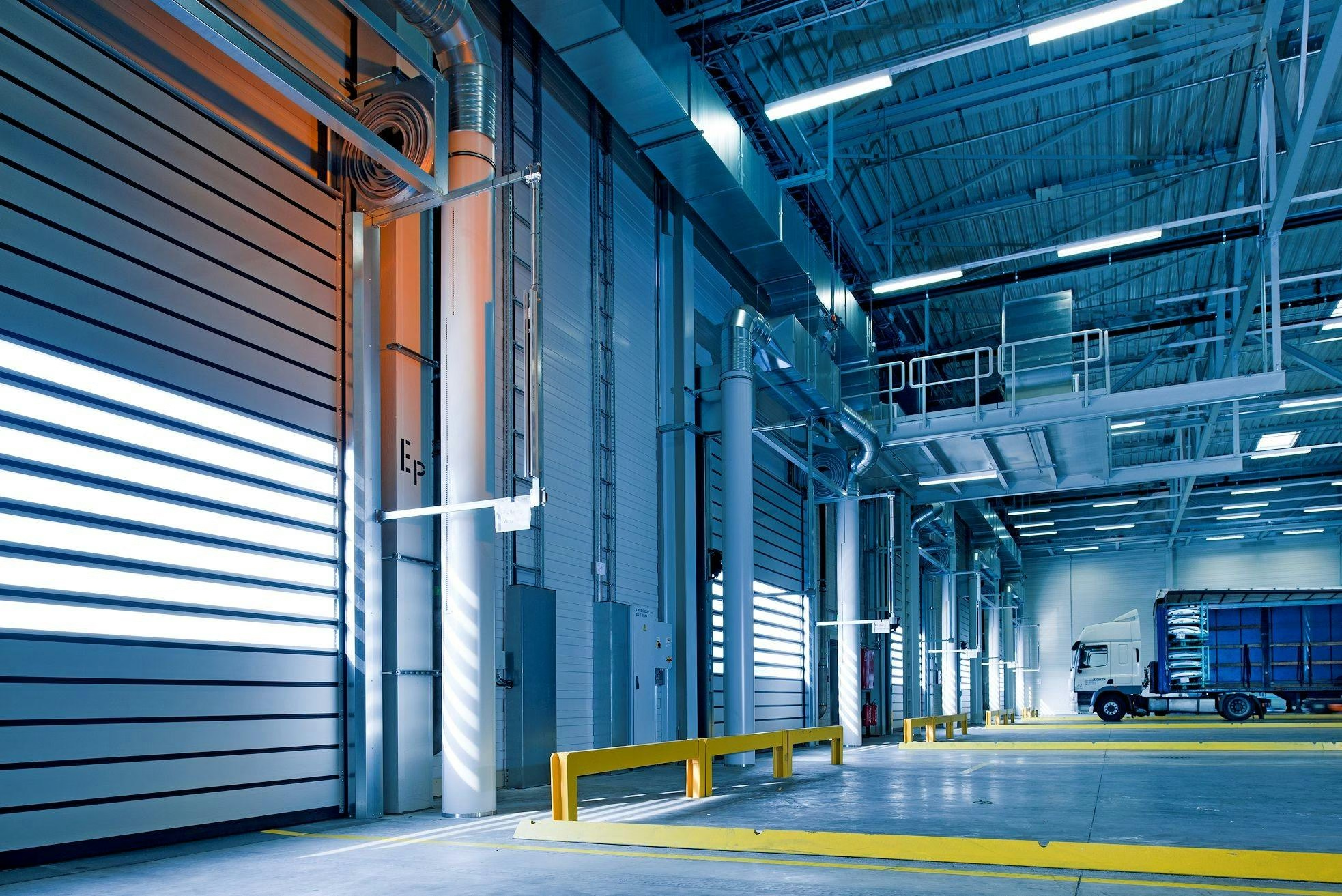
Delaware has emerged as a strategic hub for industrial growth. With its prime location between Philadelphia, Baltimore, and Washington, D.C., and access to the Port of Wilmington, the state is attracting developers who want efficient distribution networks. According to industry reports, several warehouse and industrial projects are slated for completion in 2024, clustered around major arteries like I‑95, Route 1, and Route 301 for maximum logistical efficiency.
Nationally, demand for mega distribution centers (1 million sq. ft. or more) has surged, with 49 leases signed in 2024, up from 43 in 2023. Northern Delaware is considered an emerging industrial market, offering low operational costs, affordable property taxes, and access to more than 21 million people within 100 miles.
For contractors and estimators, this growth means opportunity but also complexity. Industrial projects are large-scale, compliance-heavy, and technology-driven, requiring precise takeoffs and cost forecasting.
Key Estimating Factors for Warehouses & Distribution Centers
| Factor | Industrial Challenge | Estimating Considerations |
|---|---|---|
| Concrete Volume | Large slab pours and truck aprons | Calculate cubic yards for slabs, footings, and loading docks |
| Steel Framing | Wide-span structures with high ceilings | Include costs for joists, girders, and erection labor |
| MEP Systems | HVAC, fire suppression, and lighting for large spaces | Budget for scalable systems and energy-efficient components |
| Site Logistics | Access for heavy equipment and material staging | Add costs for cranes, pump trucks, and temporary roads |
| Zoning & Permits | Industrial zoning and stormwater management | Include admin labor for compliance and environmental reviews |
| Energy Efficiency | LEED or ENERGY STAR goals for modern facilities | Estimate for insulation, daylighting, and smart controls |
| Technology Integration | Automation, conveyors, and data infrastructure | Budget for IT cabling, sensors, and control systems |
| Timeline Pressure | Fast-track schedules for tenant occupancy | Add contingency for overtime and phased construction |
Step-by-Step Estimating Process
- Site Analysis – Evaluate soil conditions, access roads, and zoning restrictions.
- Structural Takeoffs – Calculate concrete volumes and steel tonnage for framing.
- MEP Planning – Include HVAC, fire suppression, and LED lighting systems.
- Technology Budgeting – Plan for automation, conveyors, and IT infrastructure.
- Logistics & Equipment – Budget for cranes, pump trucks, and staging areas.
- Compliance & Permits – Add administrative labor for zoning and environmental reviews.
- Schedule Contingency – Estimate labor premiums for fast-track schedules.
Real-World Example: Middletown Distribution Hub
A contractor building a 300,000 sq. ft. distribution center in Middletown:
- Estimated 4,500 cubic yards of concrete for slab and truck apron.
- Budgeted $2.8M for steel framing and erection.
- Included $1.2M for HVAC, fire suppression, and LED lighting.
- Added $500K for automation systems and IT infrastructure.
- Factored in $150K for compliance and permitting, and $250K for site logistics.
- Delivered the project on time with phased occupancy and LEED certification.
Why Accurate Estimating Matters
| Outcome | Benefit to Contractors |
|---|---|
| Cost Control | Prevents overruns on large-scale materials and labor |
| Schedule Management | Supports fast-track delivery and phased occupancy |
| Compliance Assurance | Meets zoning, stormwater, and energy code requirements |
| Client Satisfaction | Delivers scalable, efficient facilities ready for operations |
| Competitive Advantage | Wins bids in Delaware’s booming industrial market |
Additional Considerations
- Market Growth: Delaware’s industrial projects are expected to finalize in 2024, with more in early development.
- Mega Centers: National demand for 1M+ sq. ft. distribution centers is rising again after a dip in 2023.
- Northern Delaware Advantage: Affordable property taxes and access to 58 million consumers within 250 miles make the region highly attractive.
- Sustainability Goals: Many tenants demand LEED certification and energy-efficient systems, requiring estimators to plan for green materials and smart technologies.
Final Thoughts
Delaware’s industrial sector is expanding rapidly, and estimating for warehouses and distribution centers requires precision, scalability, and regulatory awareness. Builders who account for concrete volumes, steel framing, MEP systems, and technology integration will be better positioned to deliver high-performance facilities that meet market demand.
At MSB Estimating, we specialize in industrial project takeoffs across Delaware, providing CSI-formatted estimates tailored to logistics hubs, fulfillment centers, and cold storage facilities.
Need Help Estimating Industrial Projects?
Contact MSB Estimating today for accurate, scalable estimates for warehouses and distribution centers in Delaware.